
by: Carolyne Kaunda & Joan Mbodze
Introduction
Kenyans revere land. It is not just a preferred tool of investment and pathway to wealth creation; it is also a deeply rooted symbol of security. One that echoes the famous Hebrew proverb, “He is not a full man who does not own land”. But given the history of land in this country, the question that has plagued land owners and professionals in the real estate space has been that of legitimacy of title. But how did we get here?
Prior to the promulgation of the Constitution of Kenya, 2010, the registration of title to land was governed by multiple legislations including; the Indian Transfer of Property Act (ITPA), Government Lands Act (GLA), Registration of Documents Act (RDA), Registration of Titles Act (RTA), Land Titles Act (LTA), Wayleaves Act, Land Acquisition Act and Registered Land Act (RLA). These systems of registration were faced with numerous challenges such as; duplicity of titles, missing records, and illegible registers. Critically, under this regime, two systems operated side by side: the Titles system under the ITPA, RTA and RLA; and the Deeds system under the LTA (for registration of land located in Coast, Kenya) and GLA (for registration of Government land).
The Deeds system was the earliest form of registration having been introduced by the British Colonial Government in the 19th Century. The Titles system on the other hand was derived from the Torrens system, where essentially, the Government guaranteed the indefeasibility of a registered title. The principles of the Torrens system, which includes the mirror principle, insurance principle and curtain principle were incorporated through section 23(1), RTA.
A new dawn?
For many, the promulgation of the Constitution of Kenya, 2010 ushered in a new era. Viewed as a progressive approach, article 40 enshrines the right to property as one of the fundamental rights in the Bill of Rights, but with a caveat; it cannot extend to any property found to have been unlawfully acquired.
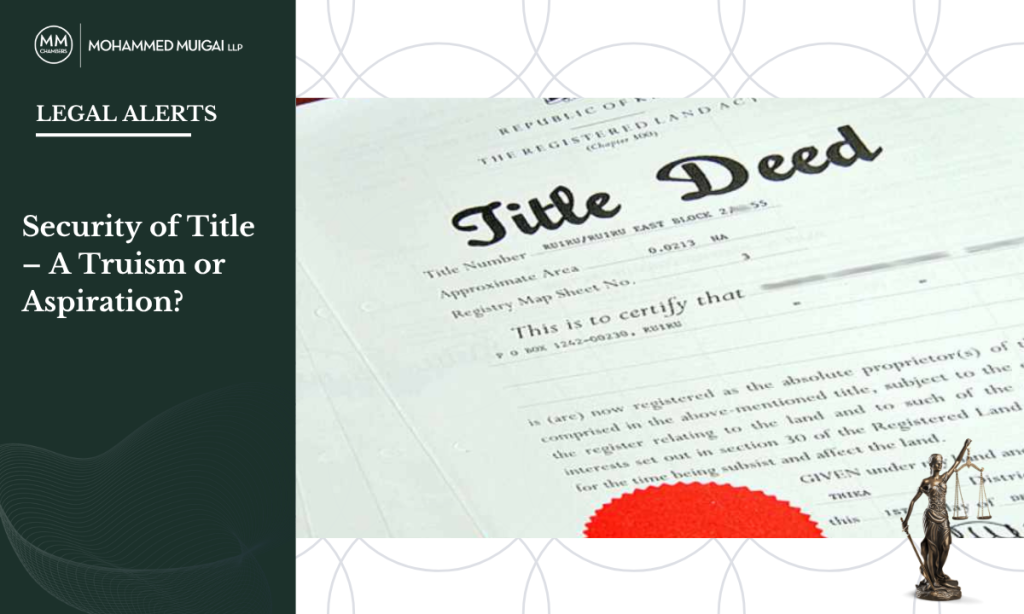
The Land Registration Act, 2012 (“the LRA”), enacted alongside the Land Act, 2012, attempts to operationalize this protection and to address the numerous challenges brought by the diverse land registration regimes. Through section 26(1), it incorporates the principles of the Torrens system previously provided under section 23(1), RTA, and the effect of land registration, is that the certificate of title is to be held as conclusive proof of proprietorship. But, has the LRA achieved its purpose, more than 10 years since its enactment?
Enter the holding of the Supreme Court in Dina Management Limited v County Government of Mombasa & 5 Others [2023] eKLR (“the Dina Management Case”), which raises various issues in light of the provisions of Article 40 of the Constitution of Kenya, 2010 and section 26 of the LRA. Key amongst them- Is the Torrens system terminated? And what level of due diligence will satisfy the threshold for one to be deemed as a bona fide purchaser for value without notice?
Brief facts:
The Appellant, Dina Management Limited alleged that the County Government of Mombasa had illegally demolished a wall on its beachfront property, violating its property rights. Its case was that a previous High Court decision had settled the question of ownership and validity of the title. The County Government of Mombasa, on the other hand argued that the land was public land and the subsequent acquisition by the Appellant was null and void. The Environment and Land Court determined in favour of the County Government of Mombasa, finding amongst other things, that the alienation of the suit property was unprocedural and unlawful for failure to seek an approved Part Development Plan (PDP) from the Director of Physical Planning as then required by the repealed Land Planning Act. The Appellant filed an appeal at the Court of Appeal which was also dismissed, leading to the Appeal at the Supreme Court.
The holding:
The decision, which has left land owners quite rattled, clarified the burden of proof to be met when the legitimacy of a registered title is challenged. The Court emphasized that simply possessing a certificate of title is not enough to shield ownership when the very foundation of that title is shaky. The owner must demonstrate the procedural propriety of the title acquisition over and beyond the registered document – up to the first proprietor. Additionally, the property must be free of any encumbrances even those not noted in the register.
This seemingly straightforward principle has ignited a lot of debate. Critics argue that it erodes the Torrens system, a cornerstone of property law known for its guarantee of indefeasibility of title. Bona fide purchasers know where the shoe pinches. They were, until the Court’s decision, assured of protection, notwithstanding that previous transactions were illegal. Proponents on the other hand, rely on the nemo dat quod non habet principle to assert that one cannot give that which they do not have.
The competing systems:
To fully understand the complexities, we must delve into the two land registration systems, the Torrens system under the RTA, RLA & ITPA (and adopted by the LRA) and the Deeds system under the GLA, RDA and LTA. The Torrens system with its emphasis on indefeasibility of title implies that a title issued under RTA could never be a nullity ab initio. Under section 23 of the RTA, a registered proprietor of land was deemed to be the owner of that property and their title was not to be challenged unless there was fraud or misrepresentation in which the owner is proved to be a party. Additionally, section 22(3) of the RTA provided a unique yet risky avenue which elevated the last proprietor’s registered title to the status of an original grant. Critics now argue that the Dina Management Case throws this guarantee into question, creating uncertainty on the essence of having a registered title if it does not form conclusive proof of ownership.
As for the Deeds system, conveyancing was by way of deed which had to be signed, sealed and delivered. For interest in land to pass, that deed had to be registered. The registry has deed plans created by surveyors. A separate folio was opened for each parcel of land and the transactions were registered against each parcel. Short particulars of each transaction were recorded in a volume called an abstract register. Copies of all deeds were kept in the registry. In essence, the deeds system was contractual in nature. The registered deed was merely evidence that a transaction existed between the contracting parties. Simply put, it formed evidence that the person on the registered deed is the owner but it was not conclusive proof that the person is the lawful owner as there was no guarantee or indemnity from the government.
Under the RTA, it was the title that was being registered and it had to conform to the statutory requirements. The government was the sole custodian of the register and the register reflected that which was issued to the owner. Could this be the reason why the government guaranteed indemnity of the title for any loss suffered as a result of any error in the register? Well, since the government had that stake, it had to ensure that only a specific category of persons could witness the registrable documents, and as such, only allowed Judges or Magistrates, Registrar of Titles, Notary public and advocates among other administrative officers as witnesses to the documents.
Historically, the deeds system was the first to develop. However, given its complexities, the Torrens system was preferred from its inception as it seemed to have met the purpose of registration. That is, to create certainty of proof of title, expedite transactions and reduce the cost of each buyer having to scrutinize each transaction – even those they were not involved in.
Is the Supreme Court’s decision taking us back to the deeds system? At the face of it, it may seem so. The Supreme Court appears to recognize that there are irregularities which cannot and should not be bypassed by virtue of someone having a title to a property. They imply that the burden is on the prospective proprietor to ensure they play their part well. But, at what point in the land acquisition process is the ball in the prospective proprietor’s court? Interestingly, your guess is as good as mine. It is during due diligence!
The question of due diligence:
Generally, due diligence involves searches and investigation of title to ensure among other things, that a purchaser acquires a good marketable title. For a deed registered under RDA, registration was simply a document being stamped with a copy being retained by the registry. Under GLA, due diligence involves a deeper scrutiny of the deed since it was the deed that was registered. The government is just recognizing that there was a registered transaction leading to the issuance of a conveyance, but beyond that, it is not vouching for its validity. The owner must prove that they followed the due process required for registration of the deed. The process culminating to the issuance of conveyance or indenture of conveyance must be interrogated. Reason being, prior to the LRA, all Government land was registered under GLA. It was noted, and exposed through the Ndung’u Report that illegal allocation of government land was prevalent and this was because the executive arm of government had immense powers to allocate land. One would therefore argue that it is only befitting that that those holding property under GLA prove the legitimacy of their proprietorship.
As a purchaser, it is therefore imperative to establish whether the property is situated in an erstwhile adjudication area and whether any conversion to the titles regime is lawful. The purchaser’s burden is to trace the legitimacy of the dealings and this entails going backwards up to the original government grant to ascertain a good root of the title. It thus appears that in the Dina Management case, the Appellant failed to prove that the original proprietor got an approved Part Development Plan from the then Commissioner for Lands as it was only after this approval that a letter of allotment was to be issued, a cadastral survey done and subsequently a certificate of lease issued to the party.
Critics argue that from the curtain principle, a purchaser need not to look beyond the register, and the purchaser should not be concerned with what is swept behind the curtain. But one would agree that a Certificate of Title can mask fraudulent acquisition, corruption and errors and omissions, leaving a rightful owner seemingly without recourse. Whether one is a critic or a proponent, we can all agree with the Supreme Court that a title or lease is an end product of a process and that shielding persons who choose to be part of an irregular transaction defeats the whole purpose of protection of the right to property. Simply put, you cannot expect a good fruit from a bad tree.
The question that remains, however, is whether placing this burden on a person who was not involved in any illegality is not in itself, onerous. What, in our view, the court failed to clarify is what remedy is available to a party such as Dina Management Limited, or even, what the duty of the State is in issuing the Titles. Is the Torrens system alive? Can we still rely on the Mirror, Curtain and Insurance Principles of land registration?
Conclusion
In a nutshell, the Supreme Court set a stringent threshold for achieving a bona fide purchaser status. The takeaway is that a purchaser must conduct due diligence – the costs notwithstanding -, especially on the always forgotten historical search to ascertain that the original owner has a good title. One can only hide under the umbrella of being a bona fide purchaser and a holder of a good title when they have conducted due diligence up to the first proprietor’s title. The practicalities of this, in the era of the “Ardhi sasa” platform are yet to be understood.
On the answer to the land question, the Supreme Court’s decision in the Dina Management Case confirms that indeed, the certificate of title does not form conclusive proof of ownership. It appears, after all, that the more things change, the more they remain the same. Security of title as pertains to land in Kenya remains an aspiration.